आज का धर्म · भागवत गाथा · पुस्तक ०
Why devotion tires: Bhakti’s sleeping sons and an age of distraction
In the Mahatmya, Bhakti is young and her sons — knowledge and detachment — are old and will not wake. A reading for anyone whose attention has worn thin.
The Editors, Naimisha Press २ मिनट
अभी केवल अंग्रेज़ी में
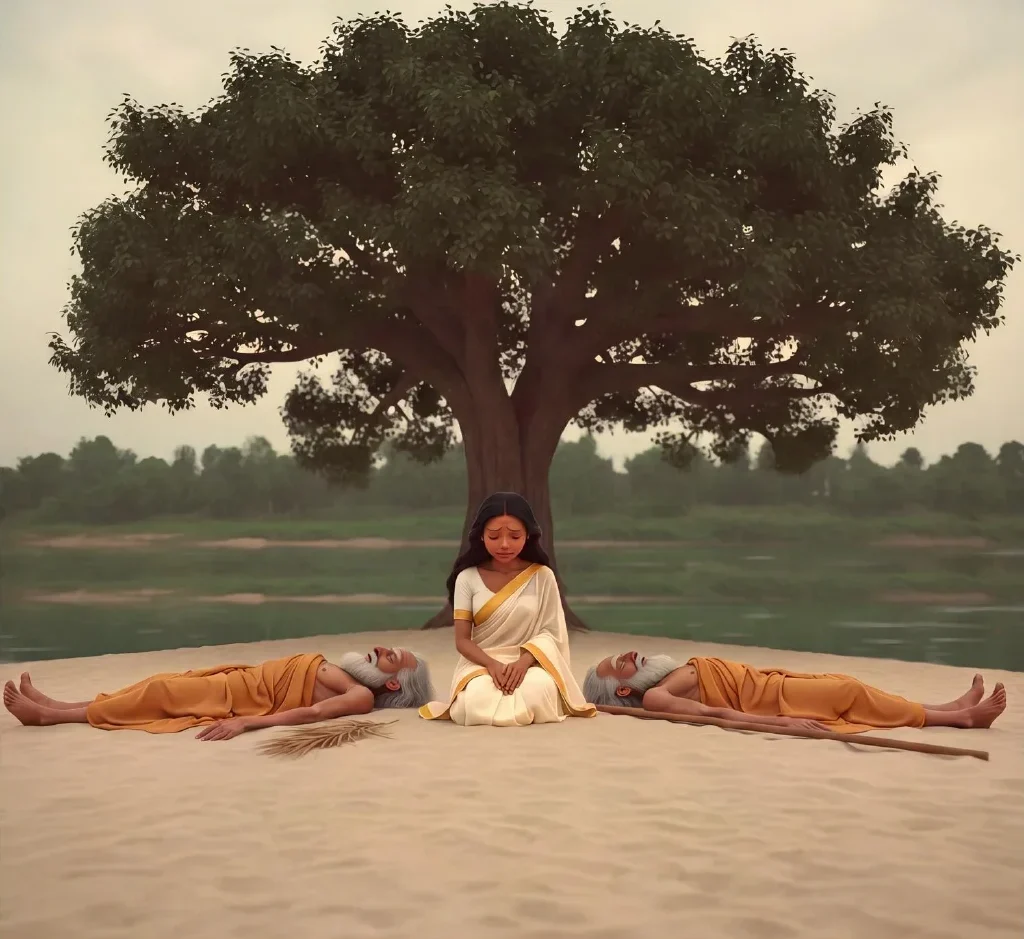
On the bank of the Yamuna, Narada finds a young woman weeping between two old men who will not wake. She is Bhakti — devotion herself. The sleepers are her sons, Jnana and Vairagya: knowledge and detachment. She is young. They are aged past rousing.
It is a strange family portrait, and the Mahatmya means it to be strange. A mother does not usually outlive her children’s youth. But this is the age of Kali, and in this age, the text says, devotion can be renewed in a single place and a single moment — while the faculties that make devotion steady are worn down by the age itself.
उत्पन्ना द्राविडे साहं वृद्धिं कर्णाटके गता ।
क्वचित्क्वचिन्महाराष्ट्रे गुर्जरे जीर्णतां गता ॥utpannā drāviḍe sāhaṃ vṛddhiṃ karṇāṭake gatā · kvacit kvacin mahārāṣṭre gurjare jīrṇatāṃ gatā
“I was born in Dravida and grew up in Karnataka; here and there in Maharashtra I was honoured, and in Gujarat I grew old.” — Bhakti to Narada, Bhagavata Mahatmya, chapter one
Information did not wake them
Narada does what any of us would try first. He recites the Vedas into the sleepers’ ears. Then the Upanishads. Then the Gita. The sons stir, yawn, and fall back asleep. The remedy is not missing knowledge — the knowledge is right there, recited in full, and it does not reach them.
That detail lands differently today. We are surrounded by recitation: answers on every screen, a verse for every mood, summaries of summaries. The Mahatmya’s picture is of a mind that has heard everything and is woken by none of it.
What did wake them
The answer, when it comes, is not a new teaching. It is a way of hearing an old one: the Bhagavata, read aloud, over seven days, on the bank of the Ganga at Haridwar. Attention, kept — not for a moment of feeling, which Bhakti already had, but for long enough that knowledge and detachment could stand up again beside her.
This is why the Bhagavata Chronicles is built as Book Zero and seven days. Not because a book can perform a rite, but because a week of sustained attention is still the most radical thing a person can offer a text — or a teacher, or a child, or a parent.
The Mahatmya never says devotion is the problem. Bhakti is the one who stays young. The question it leaves us with is quieter: what are we doing for the two who sit beside her?
Sources: Bhagavata Mahatmya (Padma Purana, Uttara Khanda), chapters one to three. Translations are the Editors’ own and follow the book’s register.
यह कहाँ से आरम्भ होता है
यह दृश्य पुस्तक ०, अध्याय एक में पढ़ें — निःशुल्क।
चौदह पृष्ठ, तीन भाषाएँ।
और पढ़ें
 सप्ताह का श्लोक
Satyaṃ paraṃ dhīmahi — the phrase that opens and closes the Bhagavata
Verse of the week. Three words at the end of the Bhagavata’s first verse, and again near its close — on the highest truth, we meditate. शिक्षाएँ
Why does the Bhagavata need a preface? The Mahatmya, explained
Six chapters from the Padma Purana are read before every saptaha. What they are, why the tradition keeps them, and why our Chronicle begins with them. शिक्षाएँ